
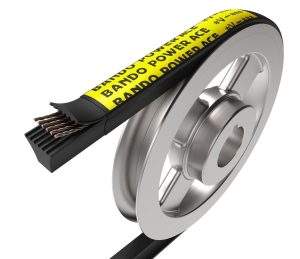
 Narrow V‑belts offer improved power transmission and are available in SPZ, SPA, SPB and SPC profiles.
Flankenoffene Keilriemen (FO) haben durch die offenen Flanken Vorteile im Verschleißverhalten und der Laufgenauigkeit.
Formgezahnte Keilriemen haben zusätzlich eine formgezahnte Innenseite (FOZ).
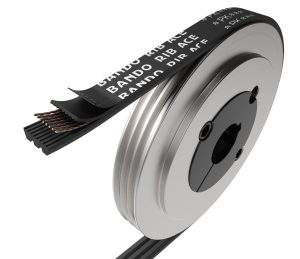 Neoprene Poly‑V belts are available in a standard version, a reinforced version with low-stretch tensile cords, an elastic version for fixed centre distances, and a dual-sided version for power transmission on both sides.
The following sizes are available:
PH = 1,60mm PJ = 2,36mm
PK = 3,56mm PL = 4,70mm
PM = 9,40mm
Advantages over conventional V‑belts include smaller pulley diameters, higher operating speeds, lower noise levels and greater efficiency.
Combination belts are also available, featuring a timing belt profile (8M / S8M) with a Poly‑V profile (PK) on the back of the belt. The ribbed belt back drives an additional pulley in the opposite direction, allowing slippage if the driven pulley becomes blocked.
PH and PJ profiles can also be manufactured in moulded polyurethane. These belts are available in very short lengths, starting from just 160 mm.
P2 to P4 profiles can be ground into flat belts or produced from extruded polyurethane belting, cut and welded to the required length.

VC6 – Single-Sided Cogged Version
DC6 – Double-Sided Cogged Version
The moulded cogged design provides a high degree of flexibility, allowing the use of V‑belt pulleys with diameters as small as 16 mm. The polyurethane casting process produces a V‑belt profile with extremely tight tolerances, resulting in exceptionally smooth and quiet operation. Unlike rubber V‑belts, the polyurethane material ensures clean operation. High resistance to oils, greases and chemicals are further advantages of BANCOLLAN V‑belts.
Extruded polyurethane V‑belts in profiles from 6 to 32 mm are available as open-ended belting, with or without tensile cords, and can be welded into endless belts of any required length.
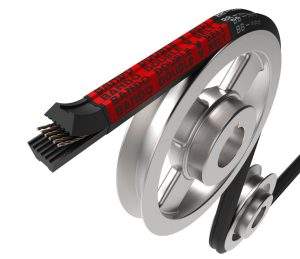
Double V‑belts allow power transmission on both sides of the belt, making it possible to reverse the direction of rotation. These belts are available in AA, BB and CC profiles.
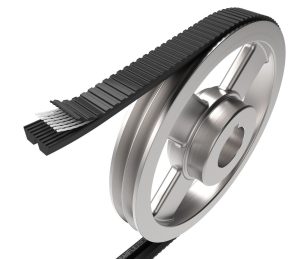
Banflex and BanfleScrum polyurethane V‑belts have been specially developed for high-speed drives with belt speeds of up to 60 m/s.
The ground belt flanks and increased flank angle ensure exceptionally low-vibration operation.
Small pulley diameters and higher operating speeds allow the design of compact, lightweight drive systems.
Horizontal drive systems can be easily implemented using BanfleScrum banded V‑belts.
The use of polyurethane gives the belt high resistance to oil and ozone. The transverse grooves on the back of the belt improve flexibility.
These belts can be used individually (Banflex) or as banded V‑belts (BanfleScrum).
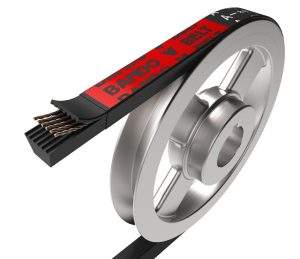 The reduced belt height and optimised positioning of the tensile cords significantly extend the service life of RED‑S II V‑belts compared with conventional belts. This belt type is particularly suitable for agricultural and horticultural machinery.